Dorfplatz Hüllhorst


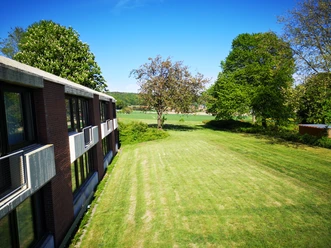
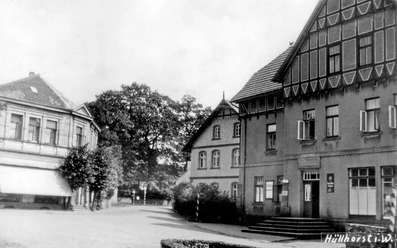
The brick building from 1909, with its striking arched windows, was completely renovated in 1951, giving the community center the exterior appearance it would retain until its demolition in 1999.
The parish hall was redesigned several times after 1951, primarily on the interior. Major renovations took place in 1963 and 1974–75. Until 1971, the southern section of the community center also housed the Hüllhorst Kindergarten.
On the ground floor, the large parish hall with a stage and a separate confirmation class room formed the central spaces. The “Teestube” (tea room), located in the basement on the north side, was used as a youth room.
The upper floor most recently housed the sexton’s apartment and the offices for the Hüllhorst Diaconal Station.&In 1998, the new parish hallin Eickhof was dedicated; the old parish hall on the village square was then demolished in 1999 after standing vacant for a year.
In the southern part of the village square, adjacent to the parsonage, stood an addition that was initially intended only as a temporary structure and storage space. The flat-roofed building, with its large windows, was initially used in part for the kindergarten. Until its demolition, the space was primarily used in the 1980s and 1990s as youth rooms for the boys’ and girls’ youth groups.
From 1710 to 1887 the old Hüllhorst parsonage stood roughly on the same site as the community center.
It served as the pastor’s workplace and as a home for him and his family. The rather small half-timbered house was struck by lightning on Sunday, July 31, 1887and burned to the ground.
The destruction of the old Hüllhorst parsonage is commemorated by an inscription carved in stone on a memorial stone on the north side of today’s parsonage: “While this building was under construction, the old parsonage, built in 1710, was reduced to ashes by lightning on July 31, 1887. May God protect the new house!”
For when the old parsonage burned down, the parsonage still in use today was already a shell.
This building, which borders the village square to the south, was also used for agricultural purposes during its first few decades. In 1968, the original stables and the farmhouse hall of the parsonage were converted into a confirmation hall.
Many residents of Hüllhorst will also remember the fruit orchards that bordered the former community center forecourt to the east.
With the construction of the main street in the mid-1970s, not only did this gem disappear, but so did the road that connected the village south of the church in an east-west direction to what is now Kurze Straße.
#ortsteilhuellhorst
Good to know
Payment methods
- Entrance Free